
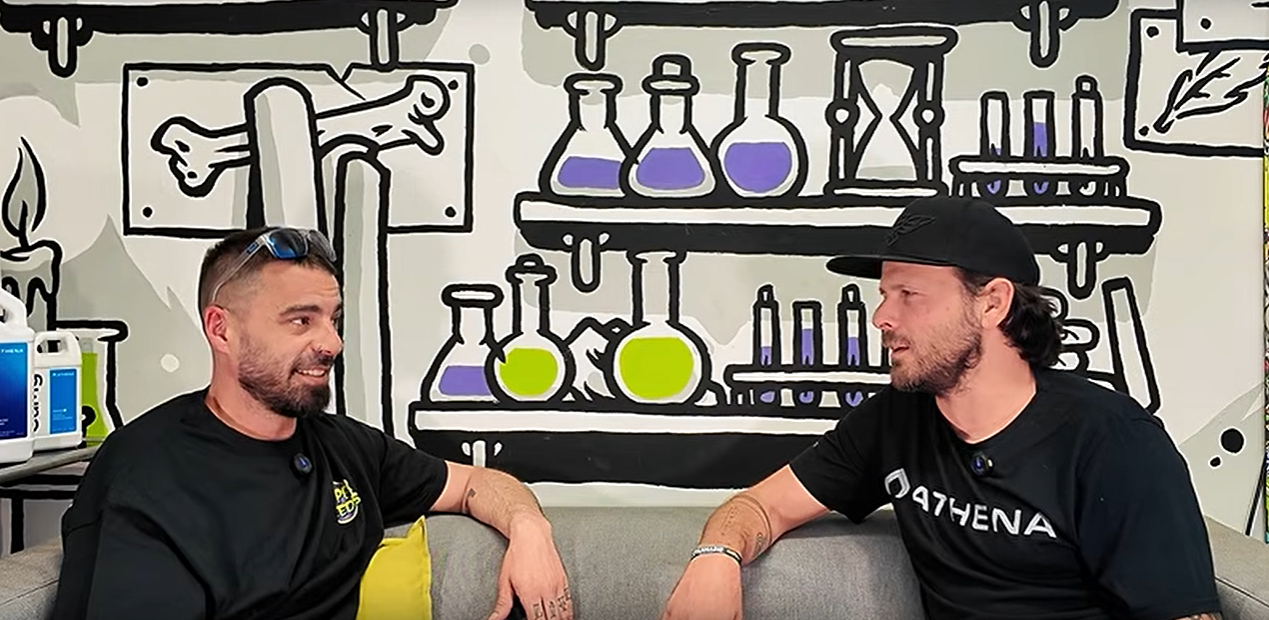
One planted his first seed at seventeen, in a house where plants grew among the tomatoes. The other, at sixteen, sowed the seeds from the pressed weed he smoked on the roof of his parents' house. More than twenty years later, David, co-founder of Ripper Seeds, and Matías Litvak of Athena sat down at our headquarters in Sabadell (Barcelona) to talk about growing.
The conversation runs a little over an hour. Here we cover the part where they talk about how they started, the trade and the industry. The rest, which is most of it, is professional cultivation at its purest: crop steering, drybacks, VPD, substrate EC, CO2 and PPFD, defoliation, drying and curing, and even mother plant quarantine and HLVd. You'll find the full video at the end of the post.
Learning to grow cannabis when there was hardly any information
Both started at a time when learning to grow depended almost entirely on trial and error. The information available was practically limited to Jorge Cervantes' book and Cannabis Café, then the largest Spanish-language cannabis forum. Matías, who planted those first seeds because he didn't want to keep smoking pressed weed, describes himself as self-taught, with his hands in the soil. David says that after his first seed he realised he enjoyed it, over time discovered he was good at it and, later on, that he could also pass that experience on to the shop's customers.
Today it's the other way round: anyone in their twenties has everything at their fingertips. David adds a nuance: what's sometimes missing is the desire to grow. They started out of necessity, and with flowers available on any shelf, much of that urgency disappears.
“I always say you only learn by doing something. Some people have a lot of theory, and that's fine, but it has to be proven.”
David, co-founder of Ripper Seeds
The stigma of working professionally in cannabis
The stigma comes up early in the conversation. David explains that the shop and the seed bank have always operated within the law. Even so, working professionally in cannabis was not as accepted as consuming it, which is why they avoided showing their faces on social media. He also points out that part of that weight didn't come from outside: it was something personal, carried over from their upbringing.
Things are different today, and that has allowed them to open up to interviews and social media. Matías looks at it from the other side: showing that this work is done by professionals with discipline, long hours and families also helps those who stigmatise the industry understand what lies behind it.
“We've got this far without doing anything outside the law, and we're proud of it.”
David, co-founder of Ripper Seeds
From a grow shop to founding a seed bank
In 2003, David opened a grow shop with Albert. During those years they selected strains they still keep today, and in 2011 Marc and Ignasi joined them so the four of them could found Ripper Seeds. For David, one of the keys to that journey is simple: in an industry where not everyone works out of passion, those who have it and are also honest are already a long way ahead.
That foundation, according to David, is what allows them to face the current moment. He has seen companies that grew very quickly now going through difficulties, and he attributes Ripper Seeds' stability to many years of work. Matías describes it as a long-distance race, at a time when the industry is narrowing due to competition, taxes and the arrival of many new players.
The life of a cannabis grower: obsession, long hours and teamwork
A good part of the conversation is about the trade itself. Matías maintains that growers are obsessive people, and David doesn't argue: he describes twenty years of working non-stop, weekends included, and admits it's hard to appreciate while you're stuck on the treadmill. He compares working with plants to livestock farming, because with living beings you're not the one setting the pace, and adds that families end up adapting to that way of life.
“You could almost call it a pathology.”
David, co-founder of Ripper Seeds
Matías gives an example any grower will recognise: he wakes up at three in the morning, sees something is wrong and gets in the car, while his wife asks him why he doesn't wait until the next day. In the shop, that same logic translates directly. When a customer needs something, they need it now, not in a week. David compares it to someone who has saved up for a pair of trainers: when they finally have the money, they want them right away. That's why they try to keep as much stock as possible.
None of this works without the right people. Both agree that the human team matters more than the best facility or the best equipment. David admits that finding those people is hard. He also insists that, beyond the commercial side, what keeps them going is passion and the desire to keep learning.
Theory and field experience in professional cultivation
At another point, David notes a change in the professional profile the industry is looking for. A few years ago it was thought that setting up a large-scale grow only took an agronomist and an investor; today the demand is for experienced growers. Matías confirms it from his work as a consultant: he came across facilities with a lot of theory and little practice, and the results were not good.
Matías adds an anecdote from when he taught at a university without having a degree. A visitor with a doctorate came to see his grow room and asked him what his doctorates were in. Matías answered with three:
“On the street, in cultivation, on the street.”
Matías Litvak, Athena
David, for his part, makes it clear that he doesn't mean to belittle anyone, that he doesn't have a degree either, but that “experience is gained in the field”. Both reach the same conclusion: what works is bringing both worlds together, with humility on both sides.
They apply that humility to their own work too. Both acknowledge that they spent years growing with their own formulas, each in their own way, and that they've had to rethink things they took for granted. For David, the key is to always be willing to learn and to keep an open mind: what isn't tried and tested isn't learned.
Cannabis strains that live up to their names
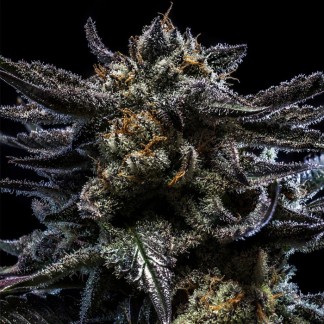
Towards the end, the conversation turns to the seed bank's philosophy. David explains that they don't promise anything they can't deliver. They work with elite clones and with their own strains developed from crosses, and they aim to bring them to growers as seeds and at a reasonable price. The condition is not to mislead with names: each strain has to be what it says it is, and if one sells out, they wait until it can be restocked. Their trips to California, he adds, help them anticipate where public preferences are heading.
The trophies are the first thing Matías sees when he walks into the headquarters, and the conversation comes back to them before they say goodbye. Due to workload, the team hasn't entered cannabis cups for a while, but David confirms they intend to return. Matías jokes that more than one competitor should start to worry; David prefers to be cautious and replies that they'll try, as always, with humility.
Meanwhile, the track record speaks for itself. The bank's strains have collected awards at cannabis cups over the years, and in the end that's what a cup is: letting others confirm that each strain is what it says it is.

Watch the full conversation
In the technical part, David and Matías explain how they use irrigation and climate to steer the plant through each phase, how to choose pot size, VPD control and its relationship with transpiration, pruning and canopy management, and drying and curing cannabis. They compare how each of them works, where they agree and where they don't.
The video is published on Athena's channel and on Matías Litvak's channel. On the blog you can also read our interview with Maxi from Antera Uruguay, another conversation between growers.