
The search for methods to optimize the quality and potency of cannabis has led growers to explore various aspects of lighting, with ultraviolet radiation being one of the most debated in recent years. Although invisible to the human eye, UV light plays a fundamental role in plant development and, potentially, in the production of the compounds we value so much in cannabis.
What is ultraviolet light?
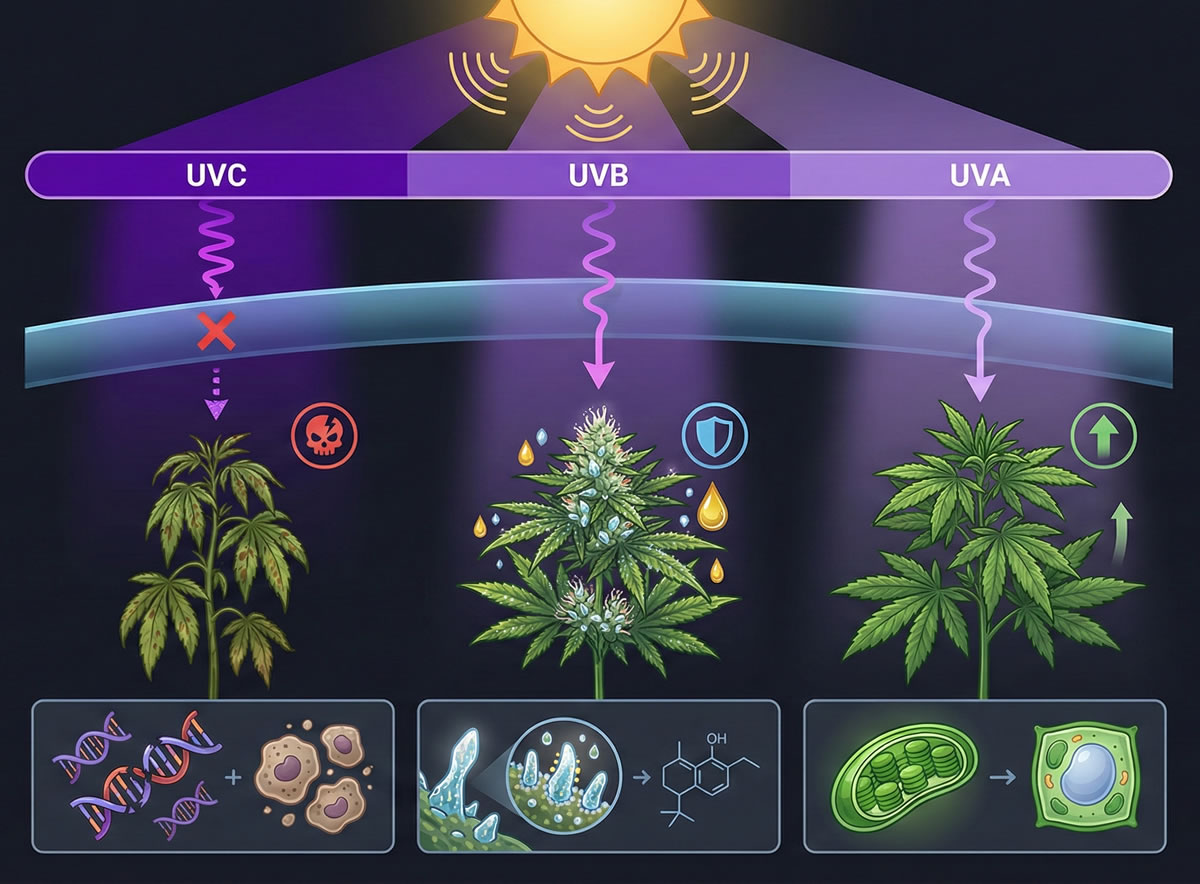
Ultraviolet light is a type of electromagnetic radiation that lies beyond the violet end of the visible spectrum, below 400 nanometers. The sun emits energy in the form of radiation that includes different wavelengths, but fortunately the ozone layer filters out much of the most harmful radiation before it reaches the Earth's surface. It is classified into three main categories according to its wavelength:
- UVA (315-400 nm) - UVA radiation represents approximately 3% of the sunlight photons that pass through the atmosphere and is the least energetic of the three.
- UVB (280-315 nm) - shorter in wavelength and therefore more energetic, it constitutes less than 0.15% of the sunlight that reaches the Earth's surface.
- UVC (180-280 nm) - is almost completely absorbed by the ozone layer and does not reach our plants under natural conditions, although it can be used for specific disinfection purposes in controlled applications.
The plant's defense mechanism against UV
To understand how UV light works in cannabis, it is essential to understand the concept of photomorphogenesis, which is the ability of plants to respond and adapt to different light wavelengths. When cannabis plants are exposed to ultraviolet radiation, they activate a complex abiotic stress response system. This response is not random: in nature, plants that grow in high mountain areas or at latitudes close to the equator receive higher UV irradiation and have developed more sophisticated protection mechanisms.
The primary way cannabis defends itself from UV radiation is through the production of trichomes, those tiny glandular structures that cover flowers and leaves with their characteristic crystalline appearance. Stalked capitate trichomes, the largest and most relevant for growers, reach between 50 and 100 microns in width and can measure up to 300 microns in height. Within these structures, cannabinoids, terpenes, and flavonoids are synthesized and stored, acting as a natural "sunscreen" for the plant.
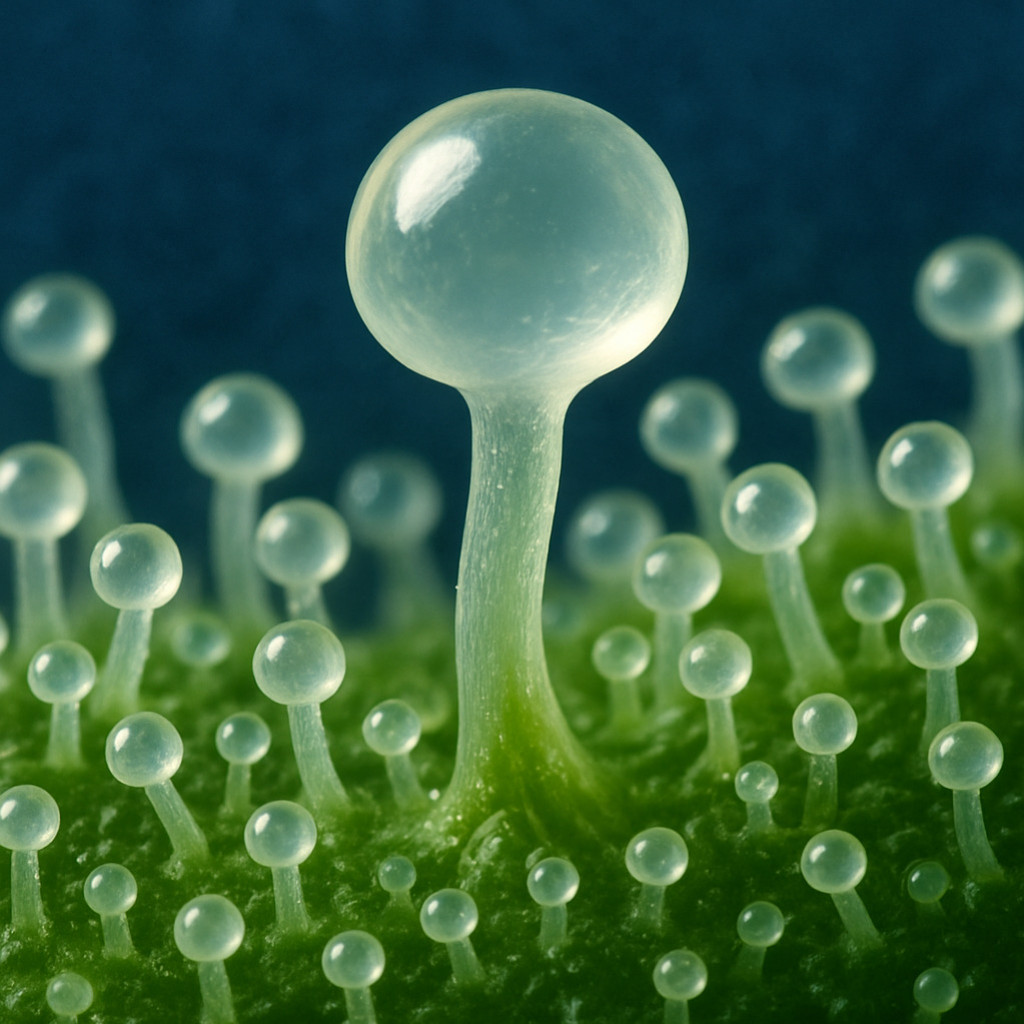
Not everything that glitters is potent. Only pedunculated glandular trichomes (with "stick") produce THC/CBD. Look for milky-amber heads, not just glitter.
Does exposure to ultraviolet light increase cannabinoid production?
Scientific interest in the relationship between UV light and cannabinoid production began decades ago. The pioneering study by Lydon, Teramura, and Coffman, published in 1987 in the journal Photochemistry and Photobiology, was the first to document that exposure to UVB radiation increased the concentration of delta-9-tetrahydrocannabinol (THC) in floral and foliar tissues of cannabis plants, although other cannabinoids were not affected. This work became a classic reference and generated the widespread belief that UV light could increase cannabis potency by up to 28%.
However, modern science has called these results into question. A more recent study by Rodriguez-Morrison and colleagues, published in Frontiers in Plant Science in 2021, found no significant increases in the concentration of THC, CBD, or CBG equivalent cannabinoids in modern cultivars exposed to UVB radiation. The researchers observed that UV exposure caused numerous morphological and physiological stress responses in the plants, but without translating into a commercially relevant increase in cannabinoids in the inflorescences.
Why this discrepancy? The most plausible explanation lies in the evolution of cannabis genetics. The varieties used in Lydon's 1987 study contained approximately 3% cannabinoids, while modern medicinal cannabis cultivars reach concentrations exceeding 15-20%. As noted in a study by Westmoreland published in Frontiers in Plant Science in 2023, it is possible that older varieties had greater potential for stress-induced upregulation of cannabinoids, while modern genotypes already operate near their maximum THC production capacity.
It appears that modern genotypes already operate near their maximum THC production capacity.
UVA light versus UVB
An important aspect often overlooked is the difference between the effects of UVA and UVB light. Research by Magagnini, Grassi, and Kotiranta, published in Medical Cannabis and Cannabinoids in 2018, demonstrated that short-wavelength irradiation, such as UVA rays and blue light, triggers the plant's stress response system. A moderate level of stress can result in increased secondary metabolite activity and, potentially, greater accumulation of cannabinoids and terpenes.
UVA light has the advantage of being the safest for both plants and workers. It does not significantly damage plant DNA and can stimulate the production of secondary metabolites without causing the severe photomorphogenic damage that UVB radiation can cause. On the other hand, UVB light is more ionizing and, although some growers report better results with it, it also carries greater risks of damage to both plants and people working in the cultivation.
The germicidal use of UVC light
Although UVC light is not suitable for stimulating cannabinoid production due to its high energy, it has specific applications in cannabis cultivation. UVC radiation can be used as a disinfection tool for controlling fungi, bacteria, and certain pests. This application, known as ultraviolet germicidal irradiation, is effective for purifying water, air, and surfaces.
However, it is essential that UVC use be carried out with extreme caution and never in the presence of plants or workers, as it can cause serious damage to plant and human tissues. Its application should be brief, controlled, and performed by trained personnel with appropriate protective equipment.
Safety considerations
Implementing UV lighting in a cannabis cultivation is not a decision to be taken lightly. Prolonged exposure to UVB radiation can cause damage to workers' skin and eyes, so it is essential to use protective glasses specific to UV cultivation environments. Conventional sunglasses may not offer sufficient protection against the intensity of UV lamps used in indoor cultivation.
In addition, UV radiation can degrade plastic materials and other grow room components, which implies additional maintenance and replacement costs. It is advisable to cover the skin during prolonged exposures and ensure that timers and control systems function properly to avoid accidental exposures.
Sources
- Lydon, J., Teramura, A. H., & Coffman, C. B. (1987). UV-B radiation effects on photosynthesis, growth and cannabinoid production of two Cannabis sativa chemotypes. Photochemistry and Photobiology, 46(2), 201-206.
- Rodriguez-Morrison, V., Llewellyn, D., & Zheng, Y. (2021). Cannabis inflorescence yield and cannabinoid concentration are not increased with exposure to short-wavelength ultraviolet-B radiation. Frontiers in Plant Science, 12, 725078.
- Llewellyn, D., Golem, S., Jones, A. M. P., & Zheng, Y. (2022). Indoor-grown cannabis yield increased proportionally with light intensity, but ultraviolet radiation did not affect yield or cannabinoid content. Frontiers in Plant Science, 13, 974018.
- Westmoreland, F. M., Bugbee, B., & Doe, M. (2023). Elevated UV photon fluxes minimally affected cannabinoid concentration in a high-CBD cultivar. Frontiers in Plant Science, 14, 1220585.
- Magagnini, G., Grassi, G., & Kotiranta, S. (2018). The effect of light spectrum on the morphology and cannabinoid content of Cannabis sativa L. Medical Cannabis and Cannabinoids, 1(1), 19-27.
- Kim, K., Kook, H. S., Jang, Y. J., Lee, W. H., Kamala-Kannan, S., Chae, J. C., & Lee, K. J. (2013). The effect of blue-light-emitting diodes on antioxidant properties and resistance to Botrytis cinerea in tomato. Journal of Plant Pathology & Microbiology, 4(9).
- Pate, D. W. (1983). Possible role of ultraviolet radiation in evolution of Cannabis chemotypes. Economic Botany, 37(4), 396-405.
- Hazekamp, A., Tejkalová, K., & Papadimitriou, S. (2005). Cannabis: from cultivar to chemovar II - a metabolomics approach to cannabis classification. Cannabis and Cannabinoid Research, 1(1), 202-215.