
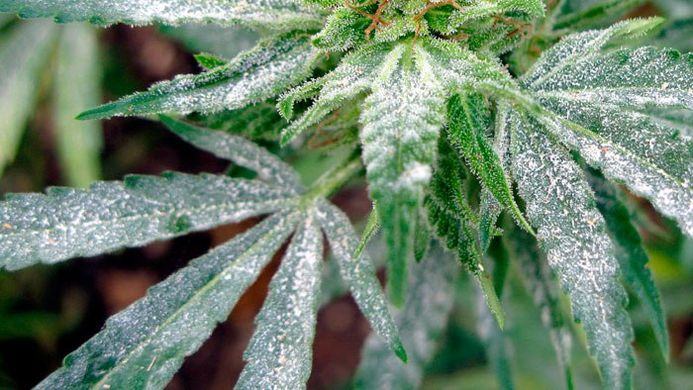
A fungus can ruin a harvest that took months in just a few days, and the worst damage usually comes in the final stretch of flowering, when buds are dense and humidity rises. On cannabis, the most damaging are botrytis and powdery mildew above ground, and fusarium at the roots. Downy mildew is less common, but it's worth knowing because it gets confused with powdery mildew and is treated differently.
Why fungus appears on cannabis plants
Fungal spores are in the air, in the soil, in the remains of previous crops and on tools. Their presence alone isn't enough to cause an infection. Three things are needed at once: the pathogen, a vulnerable plant and an environment that favors it. If one is missing, the fungus doesn't take hold, and the environment is the piece the grower controls best.
These are the factors that matter most:
- High humidity and water on plant tissue. When the night temperature drops to the dew point, a film of water forms on leaves and buds. That's what many spores need to germinate.
- Stagnant air. A mass of leaves with no air movement creates a humid microclimate inside the plant, even if the room as a whole seems fine.
- Wounds. Badly healed pruning cuts, broken stems and damage from caterpillars or mites. A plant weakened by spider mites or another mite pest has fewer defenses and more entry points for a fungus.
- Too much nitrogen. It produces soft, leafy tissue that is easier to colonize.
- Waterlogged or reused, untreated substrate. This is where root fungi survive from one season to the next.
Indoors, the most precise way to keep the climate out of the danger zone is to work with VPD (vapor pressure deficit), which combines temperature and humidity into a single value and shows how much the plant is actually transpiring. Adjusting it for each stage avoids both excess humidity and the stagnant conditions that favor most fungi.
How to tell if your cannabis plant has fungus
A plant has fungus when something appears that isn't part of its tissue: white powder that wipes off with a finger, gray or purplish fuzz, or tissue that softens and darkens from the inside. Wilting that doesn't improve after watering is another giveaway. This table is a first guide to working out which one it is:
| What you see | Where it appears | Likely cause |
|---|---|---|
| A single small yellow leaf wilting in the middle of a green bud; brown, soft interior; gray fuzz | Buds, especially the biggest ones; sometimes stems | Botrytis |
| White floury powder that wipes off with a finger | Upper side of leaves, oldest first; then stems and buds | Powdery mildew |
| Yellow or pale patches bounded by the veins, with grayish or purplish fuzz directly underneath | Patches on the upper side; fuzz on the underside | Downy mildew (uncommon) |
| Wilting that doesn't improve with watering; brown or reddish stem interior; dark, soft stem base | Roots, stem base, whole plant | Fusarium |
| Brown spots with concentric rings | Leaves and sometimes buds | Alternaria |
If the problem is on the stem, there are only two options: a brown lesion halfway up that dries out the branch above it points to botrytis; a dark, soft base, or a brown interior when cut, points to fusarium.
Before treating, rule out the lookalikes. Nutrient deficiencies cause symmetrical yellowing that follows a pattern across the whole plant, with no powder or fuzz. Light burn appears only on the part closest to the lamp. Spray residue or hard water leaves white marks that don't grow from one day to the next. A 30x to 60x loupe, the same one you use to check trichomes, helps tell a fungus apart from a simple deposit of dust or product. Always check the underside of the leaves and the inside of the biggest buds: the first symptoms are rarely in plain sight.
Botrytis or gray mold
Botrytis (Botrytis cinerea), also known as gray mold or bud rot, is the most destructive fungus for flowering cannabis. It develops at mild temperatures, roughly between 15 and 22 °C (59 and 72 °F), with relative humidity sustained above 85%, especially if there is water on the buds. That's why the risk shoots up in the last weeks of flowering outdoors, when rain, fog and cold nights arrive, and indoors when humidity rises during the dark period.
Botrytis symptoms
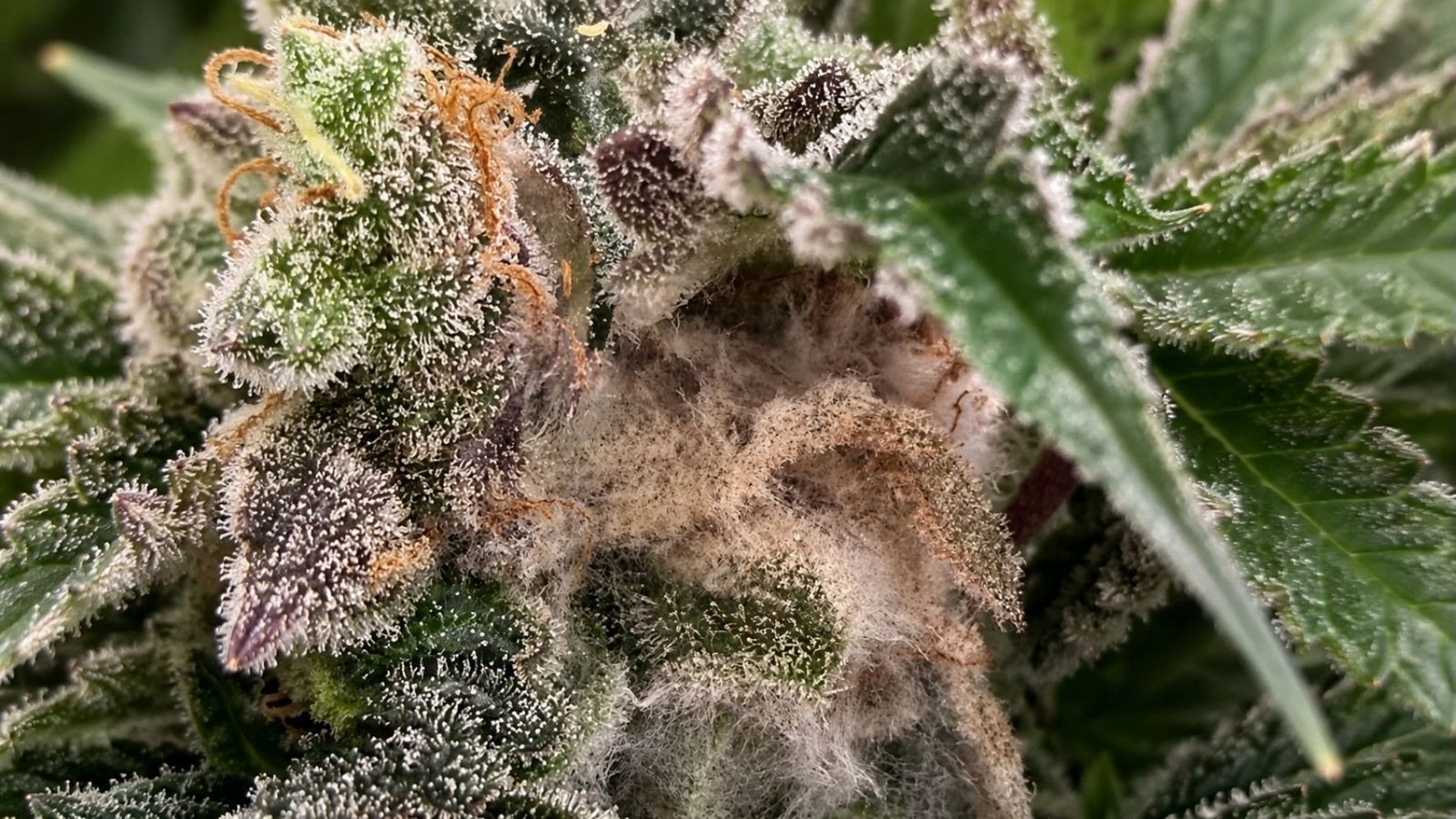
Botrytis starts on the inside. The first sign is usually a small leaf on the bud that yellows and wilts while the rest looks healthy. When you open the bud, you find brown, damp, soft tissue, and at later stages a gray fuzz that releases dust (spores) when touched. It can also attack stems: a brown lesion that strangles the branch and makes everything above it suddenly wilt.
Don't confuse it with natural senescence. At the end of flowering, sugar leaves yellow evenly as they mature, from the outside in and across the whole plant, and the tissue underneath stays firm. A leaf affected by botrytis is a lone one in the middle of a green bud, pulls out with no resistance and reveals a brown base.
Caterpillar holes are a very common entry point: the wound and the droppings keep moisture inside the bud, exactly where the fungus needs it.
How to get rid of botrytis
- Cut out the affected bud with a margin of a few inches of healthy tissue. If you can, cover it with a bag before cutting so the spores don't fall onto the rest of the plant.
- Disinfect your scissors with 70% alcohol between cuts and wash your hands before touching other plants.
- Remove the debris from the grow area, don't compost it and check the rest of the buds every day.
- Lower the humidity and increase air movement, especially at night.
- If you're at the end of flowering and the forecast calls for several days of rain, consider harvesting a few days early. Losing a little ripeness is better than losing the harvest.
Don't spray the buds with any product, homemade or not: you add moisture exactly where there shouldn't be any and leave residue on what you're going to consume. Prevention happens earlier, with Bacillus-based biological products during veg and the first weeks of flowering, with caterpillar control (Bacillus thuringiensis is the go-to biological treatment) and, above all, with climate control.
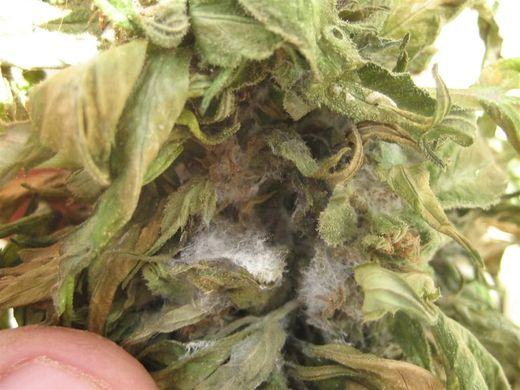
Botrytis doesn't stop at harvest. While trimming, open or squeeze the thickest buds and set aside any with a brown centre before hanging it with the rest. A bud hung with moisture inside can rot during drying, even if it looked healthy on the plant. That's why the drying room should be kept at around 18 to 21 °C (64 to 70 °F) and between 55 and 62% humidity, with air moving around the branches rather than blowing straight at them, as we explain in our guide to drying and curing cannabis.
Powdery mildew
Powdery mildew on cannabis is mainly caused by Golovinomyces ambrosiae (cited for years as Golovinomyces cichoracearum), although Podosphaera macularis, hop powdery mildew, has also been reported. Despite the similar name, it is not the same disease as downy mildew: mixing them up leads to using treatments that don't work.
It behaves differently from botrytis: it doesn't need free water on the leaf to germinate, and water actually slows it down. It thrives at temperatures of 20 to 27 °C (68 to 81 °F), moderate humidity, low light, little air movement and big differences between day and night. Its spores travel through the air, and indoors one of the most common ways in is clones of unknown origin, which can be infected without showing symptoms.
Powdery mildew symptoms
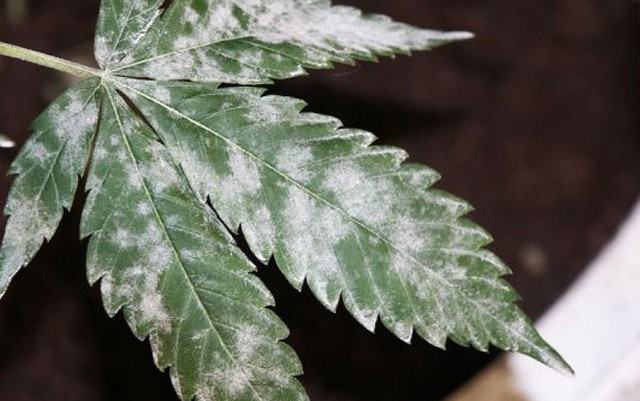
It starts as small, white, floury-looking circles on the upper side of the leaves, especially the oldest and most shaded ones. The patches grow, merge and end up covering the whole leaf. If you run a finger over it, the powder wipes off and leaves yellowish tissue underneath, because the colonized area can no longer photosynthesize properly. Left unchecked, it moves to the stems and buds, which become coated in a whitish layer.
How to get rid of powdery mildew
During veg, you have plenty of room to act. Remove and bag the worst-affected leaves and apply a foliar treatment, covering both sides of the leaf well and rotating active ingredients to avoid building resistance:
- Sulfur: preventive and curative against powdery mildew. Above 30 to 32 °C (86 to 90 °F) it can burn the leaves, and it shouldn't be applied until several weeks after an oil-based treatment, or vice versa.
- Potassium bicarbonate: works on contact, altering the pH and osmotic balance of the leaf surface.
- Biologicals: products based on Bacillus subtilis or Bacillus amyloliquefaciens, and the hyperparasitic fungus Ampelomyces quisqualis, which attacks powdery mildew directly.
In flowering, you need to tell two moments apart. In the first weeks, while the pistils are still scattered dots and haven't started clustering, you can keep applying biologicals to the leaves; sulfur, however, should stop before flowering begins, because it leaves a smell and taste. Once flowers have formed, nothing gets sprayed on them: all that's left is removing affected leaves, lowering humidity and moving the air.
Indoors, after an outbreak, replace or clean the air intake filters and clean fans and ducting before the next grow: spores lodge there and come back with the air.
As a preventive measure, potassium silicate strengthens the plant's cell walls and makes it harder for powdery mildew to penetrate the tissue. It won't cure an established infection, but in hemp trials, applied as a foliar spray, it significantly reduced its development.
Downy mildew
Downy mildew is much less common on cannabis than powdery mildew or botrytis, and is usually limited to outdoor grows in humid areas. It is caused by Pseudoperonospora cannabina and, technically, it isn't a true fungus: it's an oomycete, an organism related to brown algae. The difference matters, because some fungus treatments have no effect on it.
It needs the exact opposite of powdery mildew: cool nights, around 15 to 20 °C (59 to 68 °F), humidity above 90% and several hours of wet leaves. The spores spread with the wind and with splashes from rain or watering, and enter the leaf through the stomata.
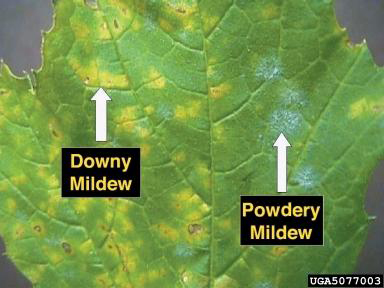
Downy mildew symptoms
Pale yellow patches appear on the upper side, often angular because the leaf veins box them in, and sometimes with a translucent or oily look. On the underside, directly beneath those patches, a gray or purplish fuzz grows, most visible first thing in the morning. Later the patches darken and the leaf drops.
To avoid confusing it with powdery mildew: powdery mildew sits on top of the leaf and wipes off with a finger; downy mildew stains the leaf from within, the fuzz is underneath and the yellow patch doesn't go away.
How to get rid of downy mildew
Remove the affected leaves, stop wetting the foliage, water early in the day and at the base of the plant, and space plants out so the air circulates. As a preventive treatment during veg, copper compounds are used (Bordeaux mixture, copper oxychloride or other forms); they are effective against oomycetes but leave residues that build up, so they must not be used in flowering. Bacillus-based biologicals are an alternative compatible with more stages.
Fusarium and other root fungi
Fusarium is a soil fungus that can survive there for several years as resting spores. On cannabis it causes two different conditions:
- Vascular wilt (Fusarium oxysporum): it enters through the roots, colonizes the vessels that carry water and blocks them. The plant wilts even though the substrate is moist, sometimes only on one side, and the lower leaves turn yellow. If you cut the stem near the base, the inside shows brown or reddish streaks running lengthwise, or a dark ring if the cut is crosswise.
- Root and crown rot (Fusarium solani and other species): the stem base darkens and softens, and the roots turn from white to brown.
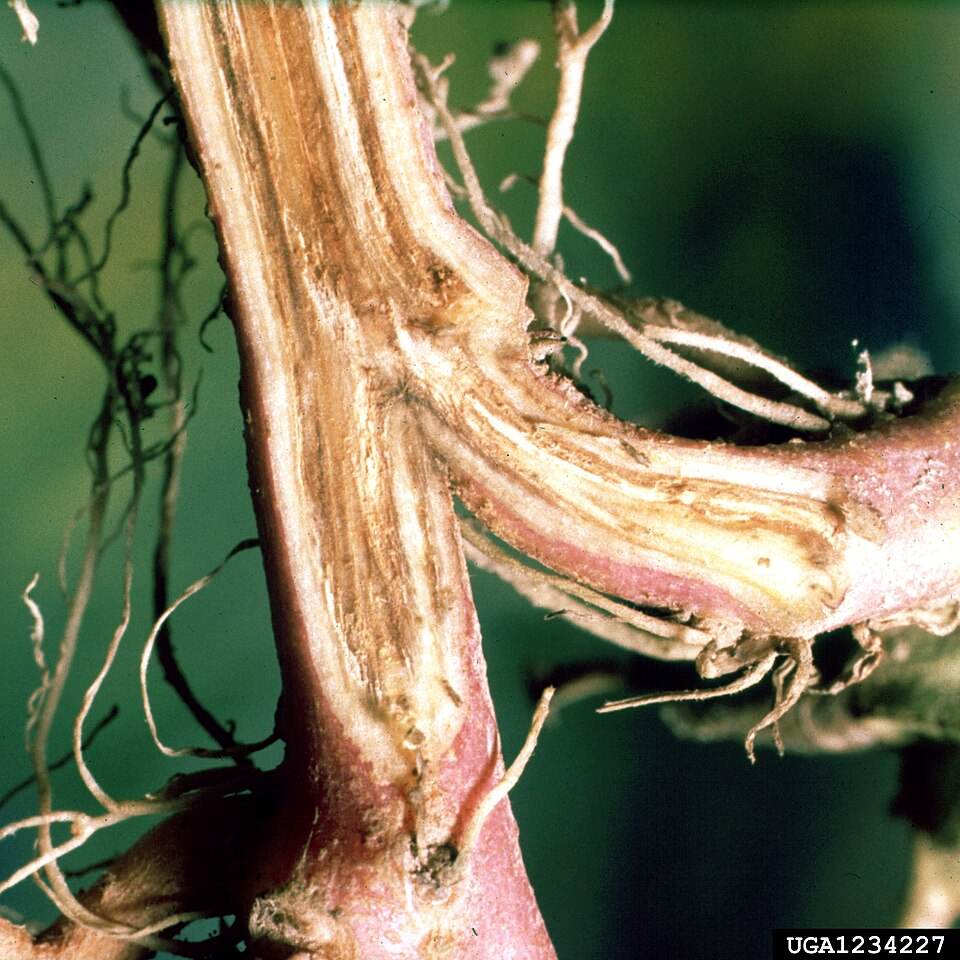
It is favored by a warm root zone (25 to 30 °C, or 77 to 86 °F), excess ammonium nitrogen, acidic substrates, overwatering and any root damage. Fungus gnat larvae deserve attention: they damage the roots and can carry spores.
What to do if fusarium appears
Once vascular infection has set in, no treatment can reverse it. The right move is to remove the whole plant with its root ball, bag it, throw away the substrate and disinfect the pot, trays, tools and irrigation system. Outdoors, avoid planting cannabis in the same spot the following season.
Prevention is the only thing that really works: new or pasteurized substrate, good drainage, watering that lets the roots breathe and beneficial fungi such as Trichoderma (for example Trichoderma harzianum), which colonize the root zone and compete with pathogens. They are applied at transplant and shouldn't be combined with broad-spectrum fungicides, which would kill them.
Pythium is a separate case: another oomycete, responsible for damping off (the collapse of newly germinated seedlings) and for root rot in hydroponics. It is favored by overwatering and nutrient solutions above 22 to 24 °C (72 to 75 °F) with little dissolved oxygen.
Alternaria
Less well known than the others, alternaria causes brown spots with concentric rings on the leaves and can reach the buds in warm, humid conditions. It usually takes advantage of plants that are already weakened and is often mistaken for nutrient deficiencies. We cover it in depth in our article on alternaria in cannabis growing.
How to get rid of fungus: treatments and when to apply them
To get rid of fungus on a cannabis plant, you need to act on three fronts at once: remove the affected material, correct the climate that allowed the infection and apply the right treatment for the fungus and the growth stage.
Almost all treatments work better before infection than after, and the criteria for choosing them are not only legal but technical. Contact products stay on the leaf surface and can be stopped before the flowers form. Systemic products enter the plant, move through it and end up in the bud you're going to consume. In every case, follow the dose and intervals on the label.
Since registered pre-harvest intervals for cannabis are rare, the practical rule is not to apply anything once flowers have formed.
When have flowers formed? In photoperiod strains, when the pistils stop being scattered dots and start clustering together, which usually happens around the second or third week after the switch to flowering, at the end of the stretch. In autoflowers, about two weeks after the first pistils appear. This is a rough guide: long-flowering strains take longer, so if in doubt, bring your last treatment forward.
With that in mind, the available types of treatment break down as follows:
- Biologicals: Bacillus subtilis, Bacillus amyloliquefaciens, Trichoderma and Ampelomyces quisqualis. They are preventive, leave little or no residue and need to be applied before the fungus establishes itself. As they are living organisms, some lose effectiveness when mixed with copper or other fungicides: check compatibility on the label before combining them.
- Minerals: sulfur (powdery mildew), copper (downy mildew and general prevention) and potassium bicarbonate (powdery mildew). They work on contact and are reserved for the vegetative stage.
- Plant extracts: horsetail (Equisetum arvense), propolis and some essential oils. They can strengthen prevention, but their effectiveness is limited and variable. They are a supplement, not a solution.
- Synthetic systemic fungicides: triazoles and similar families. Being systemic, they leave residues in the flower, and some produce toxic compounds when burned: the best-known case is myclobutanil, which releases hydrogen cyanide when it breaks down under heat. Several are no longer approved in the European Union. For home growing they aren't advisable at any stage.
| Stage | What you can do |
|---|---|
| Seedling and clone | Clean substrate, Trichoderma at the roots, quarantine for clones |
| Vegetative | Biologicals, sulfur, potassium bicarbonate, copper, silicate, pruning for airflow |
| Flowering, pistils still scattered | Biologicals on the leaves; climate and pest control |
| Flowering, pistils clustered together | Climate, ventilation, removal of affected material and early harvest if needed, nothing else |
In autoflowers, which start flowering just a few weeks after germination, the first two rows are squeezed into a very short period. Prevention has to start from the first weeks of life, because there won't be a long vegetative stage in which to correct things.
Home remedies for fungus: what works and what doesn't
- Diluted milk: has some documented effectiveness against powdery mildew on other plants, but only makes sense during veg. On flowers it leaves residue and moisture.
- Hydrogen peroxide: kills spores on contact at the surface, but offers no protection once it dries and doesn't reach the fungus inside the tissue. It's more useful for disinfecting equipment than for treating plants.
- Neem oil: can help during veg, but never in flower, because it soaks into the resin and alters smell and taste. It shouldn't be combined with sulfur either.
- Sulfur burners indoors: they are effective against powdery mildew, but they work with heat in an enclosed space, with a risk of irritant fumes and fire. Only during veg, with no plants in flower and following the manufacturer's instructions.
- Washing the buds: removes surface dust, but not the fungus inside the tissue, and adds moisture to material that is already at risk.
Mold on buds: how to spot it
On the plant, bud mold is almost always botrytis or powdery mildew, with the symptoms described above. On dried buds, botrytis shows up as a brown or gray centre when you break the bud open, and powdery mildew as a whitish, floury coating on the flower. Under a loupe, mold can be told apart from trichomes: trichomes are rounded, shiny heads on a stalk; mold forms fine, cobweb-like threads. Other signs are a musty, basement-like smell and brown or gray dust when you handle the bud. An ammonia smell in the curing jar means too much moisture: it can still be fixed, but it's the step before mold.
Can you smoke weed with fungus?
No. A bud with visible mold should not be smoked, whether it's botrytis or powdery mildew: it is colonized and loaded with spores, and may also harbour other fungi such as Aspergillus or Penicillium, which can produce mycotoxins. Smoking contaminated cannabis has been linked to cases of pulmonary aspergillosis, mainly in people with weakened immune systems, and the risk is also higher for people with asthma or other respiratory conditions. Washing or cleaning it doesn't help, because the fungus is inside the tissue. Throw away the affected bud and carefully check the ones that were next to it.
How to prevent fungus in cannabis grows
- Choose genetics suited to your climate. In humid areas, look for strains with good mold resistance and less compact flowers; in dry areas you have more leeway. No strain is immune: genetics reduce the risk but don't replace climate control.
- Leave space. Space plants apart, remove lower branches that don't get light and thin out the interior so air can pass through the plant.
- Keep the air moving. Indoors, use oscillating fans inside the space, constant extraction and, if you can, a filter on the air intake to keep out spores from outside.
- Control humidity by stage. As a guide indoors: 80 to 90% for clones, 60 to 75% in veg, 50 to 60% in early flower, 45 to 55% in mid flower and 35 to 45% in the final weeks. Pay special attention to the dark period, when humidity spikes.
- Water properly. Early in the day, at the base of the plant and without waterlogging.
- Keep things clean. Between grows, first clean thoroughly to remove debris and dust, then disinfect surfaces, tools, pots, fans and ducting with 70% alcohol, hydrogen peroxide or diluted bleach (sodium hypochlorite), always separately and with ventilation: never mix them with each other or with ammonia, because bleach releases toxic gases. Use new or treated substrate and quarantine any clone that comes from outside.
- Control pests. Mites, caterpillars and fungus gnats open the door to fungi. We cover each of them in our pests and diseases section.
- Inspect routinely. Twice a week in veg and every day in the final stretch of flowering, checking the underside of the leaves and the inside of the big buds.
None of these measures is complicated. What makes the difference is consistency, because by the time the symptom is visible, the fungus has already been at work for days.