
In cannabis cultivation, few parameters are as informative yet as frequently misinterpreted as runoff or drainage water. This term refers to the liquid that exits through the drainage holes of a pot after watering, and its analysis provides valuable information about what is happening in the root zone, that critical region where roots interact with the substrate and absorb water and nutrients.
Despite advances in fertigation, automation, and environmental control, runoff remains one of the most misunderstood concepts in cannabis cultivation. For years it has been presented as a universal standard, when in reality it is a management tool whose value depends on the cultivation system, substrate, genetics, and phenological stage.
Understanding the science behind runoff first requires understanding how plants absorb nutrients, a fascinating process that elegantly combines physics and biology. When we master these concepts, we can transform cannabis cultivation from an imprecise art into a practice based on objective data.
What is runoff?
Runoff is the volume of nutrient solution that drains by gravity after watering, once the substrate has reached its water retention capacity. This drainage is a mixture of the newly applied solution with accumulated salts, unabsorbed nutrients, and root exudates.
It is essential to clarify that runoff is not a direct analysis of the substrate or rhizosphere. It is an indirect and momentary sample, conditioned by the type of substrate, watering frequency, and the plant's physiological state. Interpreting it as a soil analysis is one of the most common mistakes and one of the main causes of unnecessary over-adjustments.
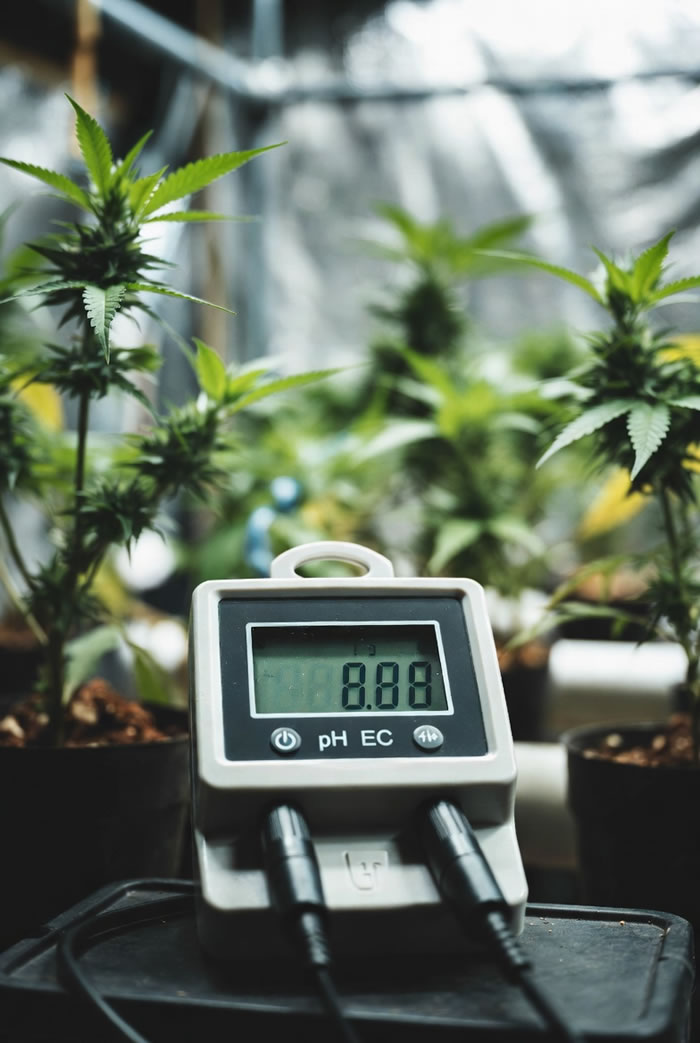
Agronomic function of runoff
In systems with mineral nutrition, nutrient absorption by the plant is neither uniform nor simultaneous. Some ions are consumed faster than others, which generates progressive accumulations that do not always manifest immediately in the aerial part.
Controlled drainage helps limit this accumulation, reduce osmotic stress at the root, and maintain a more stable chemical environment. Additionally, in inert substrates, runoff contributes to renewing the nutrient solution around the root system, which is especially important in high-vigor genetics with fast metabolism.
From a technical standpoint, the value of runoff is not in an isolated number, but in the comparison between the input and output solution, and in the evolution of this data over time.
The importance of osmosis in absorption
Cannabis plants, like all plants, depend on a physical process called osmosis to absorb water from the substrate. Osmosis is the net movement of water through a semipermeable membrane from a region of low solute concentration to a region of high solute concentration. The cell membranes of root hairs act as these semipermeable membranes, allowing water to pass through but restricting many dissolved solutes.
For osmosis to work in favor of the plant, the solute concentration inside the root cells must be greater than the concentration in the surrounding substrate water. Plants maintain this osmotic gradient by accumulating sugars and other organic compounds in their cells. When this balance is maintained, water naturally flows into the roots, creating a physical pressure known as root pressure. This pressure, along with leaf transpiration, drives water and dissolved nutrients through the xylem vessels to all parts of the plant.
However, here arises a crucial phenomenon for understanding runoff. The nutrients we add to irrigation water are also solutes that increase the total concentration of dissolved substances in the substrate. If the nutrient concentration in the substrate water becomes too high, it can exceed the concentration inside the root cells. When this occurs, the osmotic gradient reverses and the plant begins to lose water to the substrate instead of absorbing it, a process that can quickly lead to cellular dehydration and tissue damage. In cultivation, this manifests as leaf tip burn, wilting, and in extreme cases, plant death.
Electrical conductivity to measure mineral concentration
Electrical conductivity, commonly abbreviated as EC, is an indirect but extremely useful measure of the concentration of dissolved mineral salts in a solution. The principle is simple: pure water conducts electricity very poorly, but when it contains dissolved ions (like the nutrients we add in the form of mineral salts), its ability to conduct electricity increases proportionally to the concentration of these ions.
EC is typically measured in millisiemens per centimeter (mS/cm) or microsiemens per centimeter (µS/cm), depending on the meter used. It is also common to find measurements in parts per million (PPM), although this unit is less precise because different manufacturers use different conversion factors. For cannabis cultivation, EC values allow us to control how many nutrients we are providing to the plants and, equally important, how many nutrients are accumulating in the substrate.
During the vegetative growth phase of cannabis, EC values in irrigation water typically remain between 0.8 and 1.1 mS/cm for soil cultivation. During flowering, when nutritional demands increase, these values can rise to 1.5-2.0 mS/cm. However, these are guideline values that can vary depending on the specific cultivar, type of substrate, and environmental conditions. What is truly revealing is not just the EC of the irrigation water, but the EC of the runoff.
pH to control nutrient availability
pH, or hydrogen potential, measures the concentration of hydrogen ions in a solution and is expressed on a logarithmic scale ranging from 0 (very acidic) to 14 (very alkaline), with 7 being neutral. For cannabis plants, pH is not simply a chemical curiosity, but a determining factor in nutrient availability.
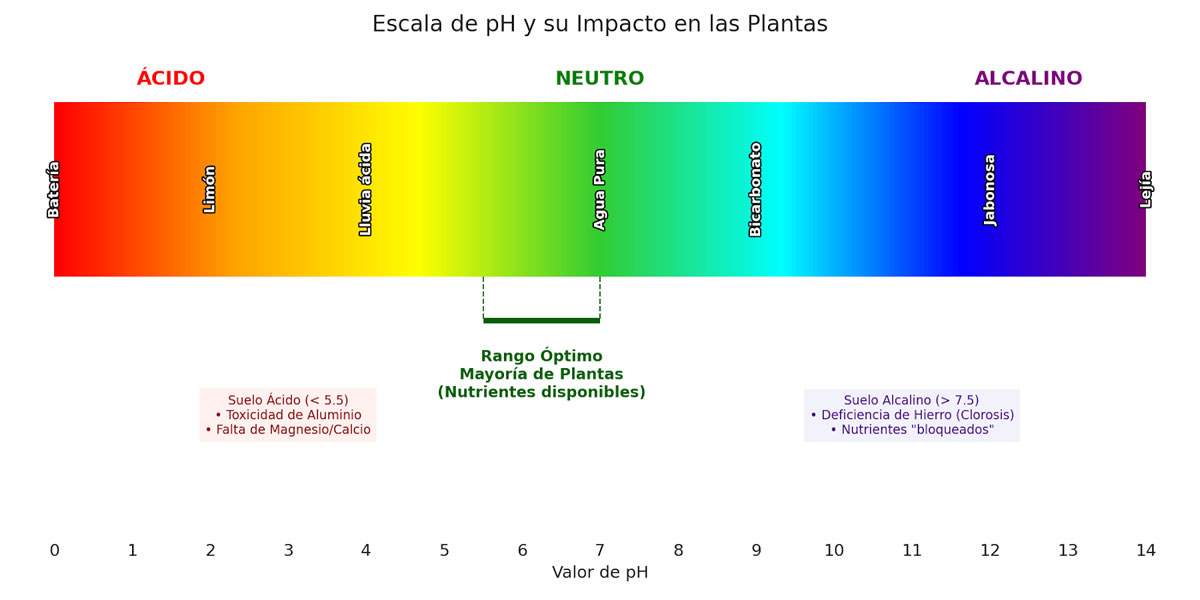
Each essential nutrient has an optimal pH range in which it is most soluble and therefore most easily absorbed by the roots. For example, iron becomes less available in alkaline pH, while phosphorus has problems in both very acidic and very alkaline pH.
For cannabis grown in soil, the optimal pH range is between 6.0 and 6.5, where most nutrients present adequate availability. In hydroponic or coco cultivation, the optimal range is slightly lower, between 5.5 and 6.1.
As with EC, runoff pH can differ significantly from irrigation water pH, and this difference provides us with valuable information about the chemical reactions occurring in the substrate.
The importance of substrate in runoff interpretation
| Substrate Type | Input EC (mS/cm) | Ideal Runoff EC (difference) | % Drainage | Input pH | Runoff pH |
|---|---|---|---|---|---|
| Soil (organic) | 0.8 - 1.5 Veg: 0.8-1.1 Flower: 1.2-1.5 |
+0.1 to +0.3 Tolerant to variation |
10-15% Not critical |
6.0 - 6.5 | 6.0 - 6.8 Wide range OK |
| Coco Coir | 1.2 - 2.0 Veg: 1.2-1.5 Flower: 1.6-2.0 |
+0.1 to +0.5 Important control |
15-20% MANDATORY |
5.8 - 6.2 | 5.8 - 6.4 Monitor closely |
| Hydroponics / Rockwool | 1.5 - 2.2 Veg: 1.5-1.8 Flower: 1.8-2.2 |
+0.0 to +0.2 Critical control |
20-30% ESSENTIAL |
5.5 - 6.0 | 5.5 - 6.1 Narrow range |
How to interpret this table:
- Runoff EC: If the difference exceeds +0.5-0.7 mS/cm, consider reducing fertilization or increasing drainage
- % Drainage: Calculated as: (runoff volume / irrigation volume) × 100
- Trend > Single value: Monitor over 3-5 waterings before making drastic adjustments
- Alert: Runoff EC > input + 1.0, consider corrective flushing
The meaning of runoff changes radically depending on the growing medium used. Understanding these differences is fundamental to correctly interpreting the data.
Soil cultivation
Soil presents high buffer capacity, high cation exchange, and intense biological activity. These characteristics buffer pH and EC changes, which means runoff values have limited value as a fine-tuning tool.
Organic substrates have buffer capacity and cation exchange, which means they can retain and release nutrients more gradually, cushioning abrupt changes. In these systems, it is more important to follow the fertilizer manufacturer's recommendations and observe the plants than to obsess over every tenth of EC in the runoff.
In this context, drainage primarily serves a preventive function, helping to avoid excessive saturations and extreme accumulations, but should not be used as the main reference for modifying fertilization.
Coco cultivation
Coco is a technically inert substrate, with low buffer capacity and very fast response to the nutrient solution. In this system, runoff acquires a central role in crop management.
The absence of drainage in coco typically translates into accumulations of potassium and calcium, imbalances with magnesium, and progressive increases in electrical conductivity in the rhizosphere. In these cases, problems usually appear late, when stress is already significant.
In coco cultivation, runoff is not an option, but a structural part of the irrigation and nutrition system.
Completely inert systems
In rockwool and hydroponic systems, the substrate does not correct or buffer any imbalance. Everything depends on the supplied nutrient solution and its constant renewal.
In these systems, runoff is essential and is used as a continuous control tool to adjust EC and pH and maintain crop stability.
How much runoff is adequate?
In most coco cultivation, a drainage range of 10 to 20% of irrigation volume is functional and technically correct. Below that range, the risk of accumulation increases; well above it, continuous washing occurs that reduces system efficiency.
This percentage is not fixed and must adapt to factors such as crop phase, root system size, watering frequency, environmental conditions, and cultivated genetics. Without this context, any figure loses technical meaning.
Interpreting runoff in cannabis cultivation
When we water our cannabis plants, water passes through the substrate carrying with it the mineral salts that have accumulated around the roots. Runoff, therefore, acts as a sample of what is really present in the root zone. However, its interpretation requires more than comparing numbers.
EC runoff interpretation
The electrical conductivity of runoff only has value when compared with the EC of the input solution.
Under ideal conditions, runoff EC should be slightly higher than irrigation water EC. This indicates that plants are absorbing water faster than nutrients, which is normal and healthy. A moderate difference, for example, watering with EC of 1.5 and obtaining runoff of 1.8-2.0, suggests an adequate balance. Plants are feeding, but there is no worrying salt accumulation.
Fertilizer manufacturers oriented toward professional cultivation, such as Athena Nutrients, recommend interpreting runoff EC within an operational range. Their technical guides describe as typical a runoff with values slightly higher than input EC, generally between one and two tenths, depending on the crop phase, as indicative of controlled accumulation and a stable root environment.
However, when runoff EC is significantly higher than irrigation water EC, for example, watering with 1.5 and obtaining runoff of 2.5 or higher, we are facing salt accumulation in the substrate. This accumulation occurs because we continuously add more nutrients than plants can absorb. With each watering, new salts are added while part of the old ones remain in the substrate. Water evaporates or is absorbed, but salts cannot evaporate, so their concentration progressively increases.

In this article we will have the opportunity to talk about the quality of the water we use for our marijuana plants. We will also see the importance of using a correct pH in each irrigation and the...
This salt accumulation has serious consequences. As salt concentration around the roots increases, the osmotic pressure of the substrate also increases. Roots find it increasingly difficult to absorb water, and in extreme cases, as mentioned earlier, the osmotic gradient can reverse. Additionally, very high concentrations of certain ions can be directly toxic to roots. The visible result is what growers call "nutrient burn": brown leaf tips and edges, dark green claw-shaped leaves, and stunted overall growth.
More important than the single value is the trend observed over several consecutive waterings. Adjusting fertilization based on a single measurement usually generates instability and unnecessary stress.
Runoff pH and its limitations
Runoff pH also deserves attention. If runoff pH differs significantly from irrigation water pH, it indicates that the substrate is acting as a chemical buffer, modifying pH. For example, if we water with pH 6.0 but runoff comes out at pH 5.0, the substrate is acidifying, possibly due to accumulation of certain fertilizers or microbial activity. A pH that drifts outside the optimal range can cause nutrient lockouts even when these are present in the substrate, simply because they are not in a chemically absorbable form.
Runoff pH can provide information about differential absorption processes, ion exchange, and root activity. However, it does not always accurately represent the actual pH of the rhizosphere, especially in substrates with high buffer capacity.
According to practical experience collected in irrigation protocols such as those from Athena Nutrients, an output pH slightly higher than input pH is usually associated with a functional root environment, while persistently lower values may indicate problems with excess moisture or nutrient absorption imbalances.
As with EC, runoff pH should be evaluated as a trend and not as isolated data.
Corrective root flushing
When we detect excessive salt accumulation through elevated EC measurements in runoff, the solution is to perform a root flush. This process consists of passing through the substrate a much larger volume of water than usual, typically two or three times the pot capacity, with the goal of mechanically flushing out the accumulated excess salts.
The water used for flushing must have adjusted pH to the optimal range for cultivation (6.0-6.5 for soil, 5.5-6.0 for hydro/coco) but very low EC, ideally close to zero. Reverse osmosis water or distilled water are excellent options, although tap water with low EC can also work. The key is that we are not adding more nutrients during the flush, only removing those already in excess.
The flushing process takes advantage of the principle of leaching: salts dissolved in the substrate water are carried away by the continuous flow of fresh water. As water passes through the substrate, it dissolves accumulated salts and carries them out. If we perform the flush correctly, runoff EC should progressively decrease until reaching values close to those of the flush water, typically between 0.2 and 0.5 mS/cm.
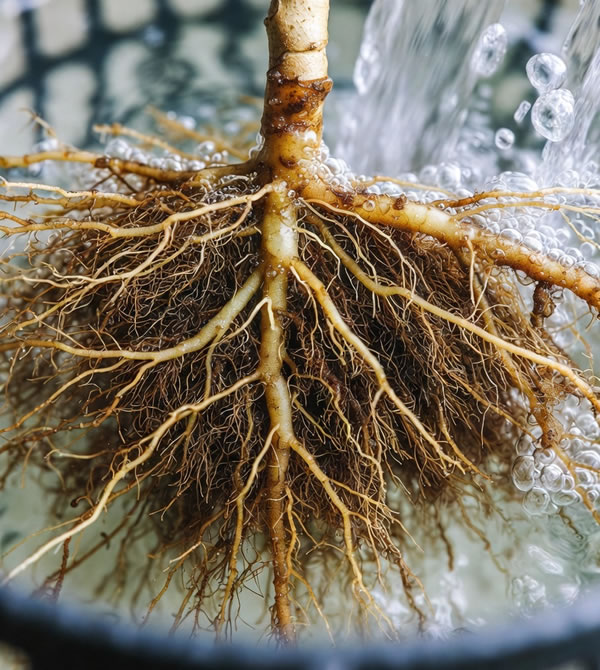
It is important not to confuse corrective root flushing with the pre-harvest flush that some growers perform in the final weeks of flowering. Corrective flushing responds to a salt accumulation problem and can be done at any time in the cycle. After a corrective flush, once the substrate partially dries, fertilization should be resumed with appropriate EC values for the growth phase.
Relationship between runoff, irrigation, and root oxygenation
Runoff cannot be analyzed in isolation. It is directly linked to irrigation volume, frequency, and substrate aeration.
Excessive frequency combined with high drainage leads to constant washing. Low frequency with little drainage favors salt accumulation. Proper technical management seeks to saturate the substrate without waterlogging it, drain without excessive washing, and promote root system oxygenation after each watering.
In manual and automated irrigation strategies, runoff measurement is used as a tool to verify proper system functioning, not as a substitute for direct plant observation.
The genetic variable in runoff response
Not all cannabis genetics respond equally to salt accumulation. There are clear differences in root architecture, absorption speed, and tolerance to elevated electrical conductivity levels.
Two plants grown in the same system can show very different responses to the same runoff level. Therefore, drainage management must adapt not only to the substrate and system, but also to the specific genetics being cultivated.
Practical considerations and runoff limitations
Despite its usefulness, runoff analysis has limitations we must recognize. First, runoff represents a sample of what water has dissolved in its passage through the substrate, but does not necessarily accurately reflect conditions in all zones of the pot. Roots are not uniformly distributed and there may be zones with very different concentrations.
Temperature also influences EC measurements, although most modern meters perform automatic temperature compensation. For pH measurements, temperature is less critical, but regular meter calibration is essential to maintain accuracy.
Another factor to consider is the measurement timing. The first runoff that comes out after starting watering can have very different values than the last. To obtain a more representative reading, it is recommended to collect runoff after approximately 10-20% of the added water volume has come out, discarding the first that comes out.
At the same time, we must not forget that we are cultivating living organisms that respond to their environment in complex ways. Nutrient absorption is not a purely passive process. In addition to osmosis, roots use active transport to absorb certain nutrients, which is influenced by factors such as substrate temperature, oxygen availability, and the plant's overall health.
The cannabis root zone also harbors a complex ecosystem of microorganisms. Beneficial bacteria and mycorrhizal fungi can significantly modify nutrient availability, improve substrate structure, and protect against pathogens. These microorganisms can alter local pH around roots and facilitate nutrient absorption through various symbioses. In organic cultivation that depends on this microbial network, EC and pH parameters may be less predictive because much of the nutrition occurs through these complex biological relationships.
Transpiration also plays a crucial role. During the day, when the plant transpires actively, the flow of water and nutrients from roots to leaves is maximum. At night, when transpiration is reduced, this flow decreases significantly. This means nutrient absorption is not constant throughout the day, and environmental factors such as relative humidity, temperature, and light intensity indirectly influence nutrition by affecting the transpiration rate.
Common mistakes in runoff use
Among the most common mistakes are:
- Using runoff as the only decision-making tool
- Adjusting fertilization based on a single measurement
- Routine flushing without a real cause
- Substituting plant observation with isolated numbers
Runoff is a technical aid, not a substitute for physiological crop reading.
Reference sources
- Atlas Scientific. (2025). "How To Fix And Prevent Nutrient Lockout." Atlas Scientific Blog.
- CannaConnection. "What is osmosis and why is it important for cannabis plants?"
- FloraFlex Media. (2023). "Reverse Osmosis in Cannabis: Unlocking the Power of Purified Water."
- Hammer, R. "Osmosis and Plant Nutrition."
- I Love Growing Marijuana. (2025). "How do marijuana plants absorb water and nutrients?"
- I Love Growing Marijuana. (2025). "'Osmosis' Effect On Cannabis Plants."
- Maximum Yield. (2019). "Water and Nutrient Uptake by Roots."