
The development of LED technologies has revolutionized cannabis cultivation in controlled environments, allowing precise manipulation of the light spectrum to optimize both vegetative growth and the production of secondary metabolites (THC, terpenes, etc.). Among the most relevant photobiological phenomena for understanding plant responses to different wavelengths is the Emerson effect, a synergistic mechanism discovered more than six decades ago that today redefines horticultural lighting strategies.
In a nutshell: combining deep red light with far-red allows plants to use light more efficiently, produce more biomass and, in the case of cannabis, more cannabinoids.
Discovery of the Emerson effect
In the 1950s, American scientist Robert Emerson conducted fundamental experiments that changed our understanding of photosynthesis. While researching with green algae of the genus Chlorella, Emerson observed a phenomenon that seemed contradictory to established knowledge about light absorption by chlorophylls.
Emerson discovered that when plants were exposed to light with wavelengths above 680 nanometers (nm), in the far-red region, photosynthetic efficiency decreased abruptly, despite chlorophyll still absorbing light in this spectral range. This abrupt decline in the quantum yield of oxygen evolution above 685 nm was termed "red drop."
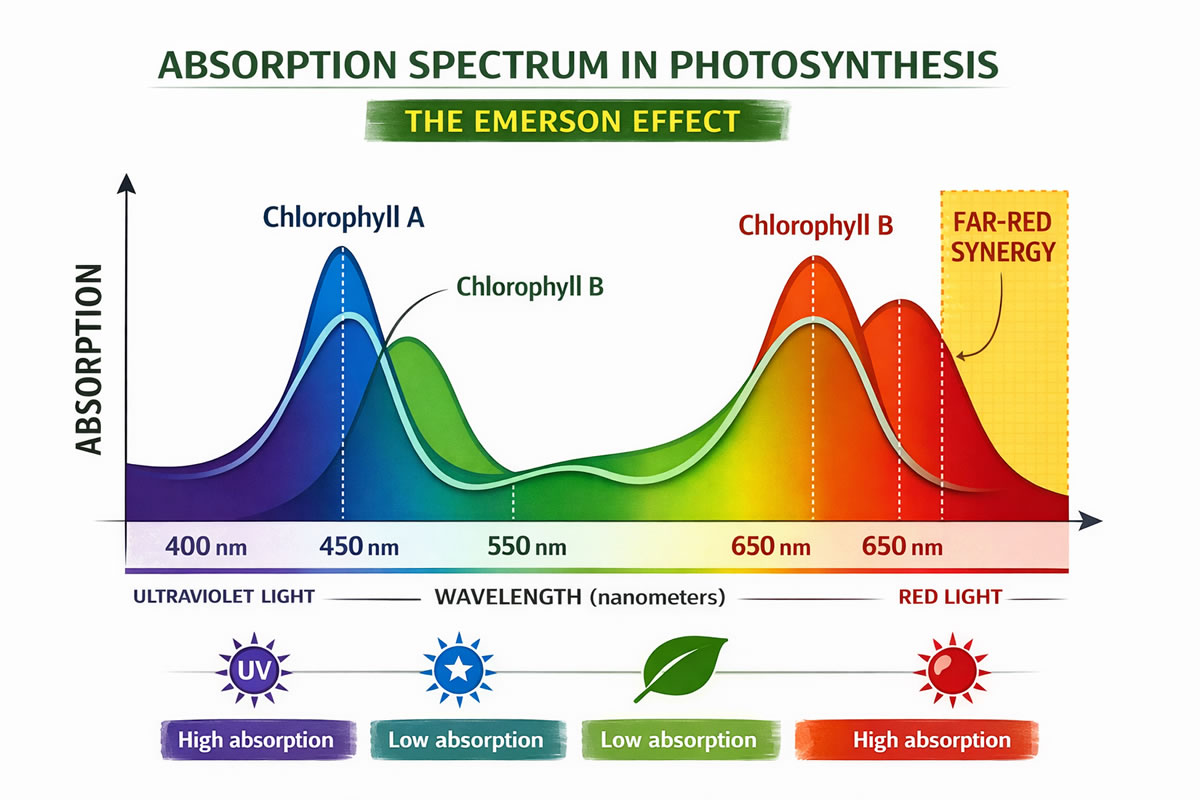
The truly revolutionary discovery came when Emerson simultaneously exposed plants to short-wavelength light (less than 680 nm, in deep red) and long-wavelength light (greater than 680 nm, in far-red). The result was surprising: the photosynthesis rate under combined illumination was significantly higher than the sum of rates when each wavelength was applied separately.
This synergistic effect led Emerson to postulate in 1957 that there must exist two distinct photosynthetic systems operating in cooperation, each optimally excited by different wavelengths. This hypothesis proved correct and led to the discovery of photosystems I and II, fundamental to understanding the molecular architecture of photosynthesis (Wikipedia, 2024).
Biophysical fundamentals of photosynthesis
Photosystems I and II
Oxygenic photosynthesis in higher plants depends on two multimeric protein complexes embedded in the thylakoid membranes of chloroplasts: photosystem II (PSII) and photosystem I (PSI). These complexes were named in order of discovery, though counterintuitively PSII acts first in the sequence of light reactions.
- PSII, also known as P680 for its absorption peak at 680 nm, is responsible for water photolysis and initial generation of energized electrons. This complex is optimally excited by photons in the 400-680 nm range, with maximum absorption in the blue (440-450 nm) and red (660-680 nm) regions of the spectrum.
- PSI, named P700 for its absorption peak at 700 nm, accepts electrons from PSII through the electron transport chain and further energizes them to produce NADPH, a carrier of reducing power essential for carbohydrate synthesis. Crucially, PSI can be efficiently excited by far-red photons up to approximately 732 nm.
The two photosystems operate in series, not in parallel, within the photosynthetic electron transport chain. Electron flow follows this simplified sequence: PSII uses light energy to extract electrons from water, generating molecular oxygen as a byproduct. These electrons are transferred through a series of carriers, including plastoquinone (PQ), the cytochrome b6f complex, and plastocyanin, until they reach PSI.
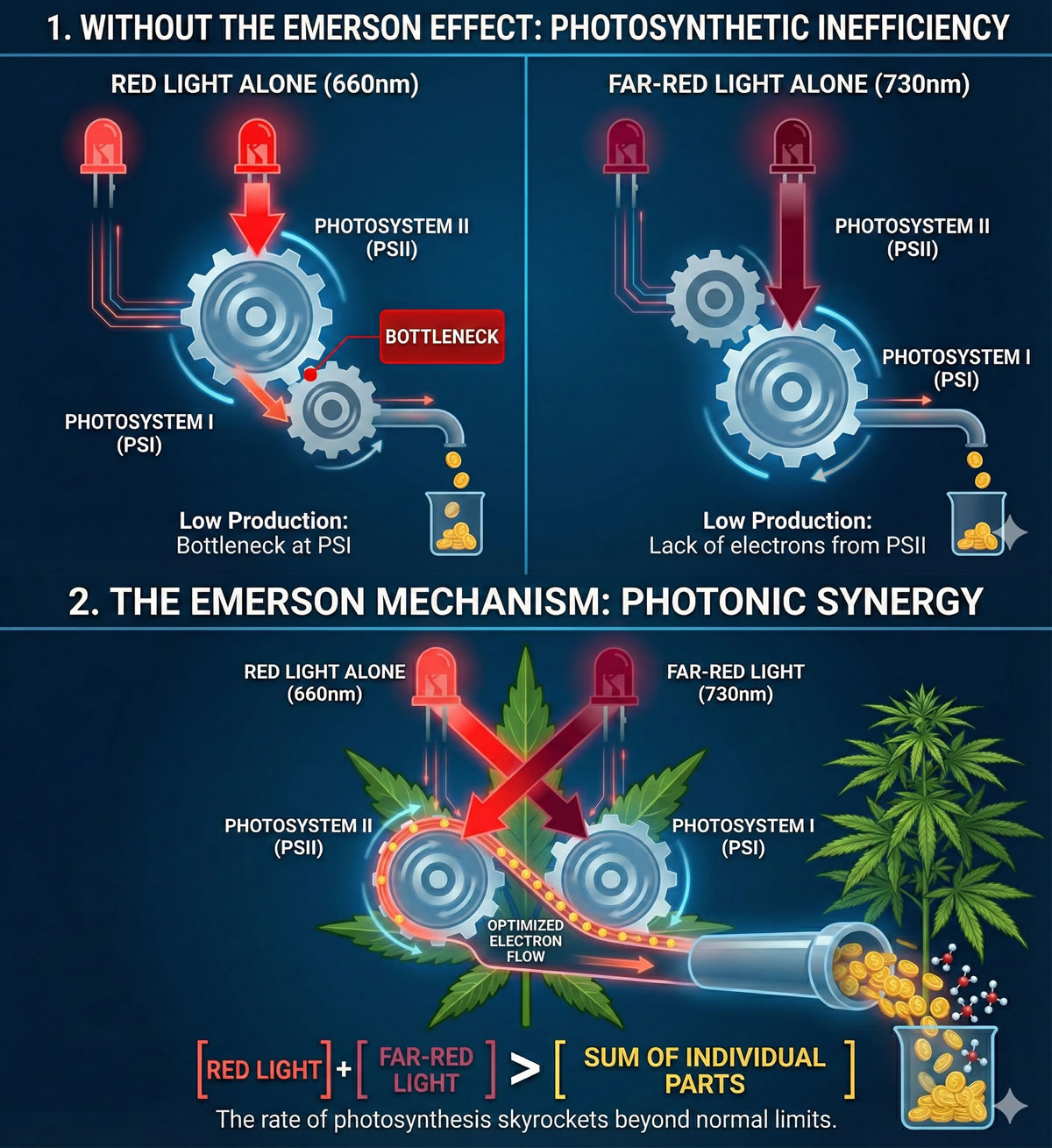
For this system to function with maximum efficiency, both photosystems must be excited approximately equally. An imbalance in excitation results in metabolic bottlenecks that reduce the overall rate of photosynthesis.
Application of the Emerson effect in LED technologies
For decades, practical exploration of the Emerson effect was limited by the impossibility of generating far-red light in an isolated and efficient manner. Traditional light sources such as high-pressure sodium (HPS) or metal halide (MH) lamps produce continuous spectra that include far-red, but do not allow its independent manipulation.
The development of efficient LEDs capable of emitting in the 700-750 nm range has revolutionized this situation, allowing for the first time the design of precise spectra that exploit the Emerson effect in a controlled manner. Far-red LEDs with emission peaks around 730 nm have become standard components in advanced horticultural lighting systems.
The advantage of LEDs is not only the ability to generate specific wavelengths, but also the possibility of dynamically modulating their intensity and duration. This allows implementation of sophisticated lighting strategies that exploit both the Emerson effect for photosynthetic optimization and phytochrome manipulation for morphological and reproductive control.
Effects of far-red on Cannabis sativa
In essence, the Emerson effect has two notable effects that can be leveraged to optimize cannabis crop production:
- Photosynthesis optimization: far-red light improves photosynthetic efficiency by optimizing the balance between photosystems.
- Phytochrome-mediated shade avoidance: affects plant morphology and phenology.
Phytochromes and the shade avoidance syndrome
Phytochromes are protein photoreceptors that exist in two interconvertible forms: Pr (inactive form that absorbs red light ~650-670 nm) and Pfr (active form that absorbs far-red light ~705-740 nm). Red light converts Pr to Pfr, while far-red light performs the reverse conversion.
The Pfr/Pr ratio acts as a sensor of the light environment. In full sun conditions, where red light predominates, the Pfr/Pr ratio is high. When plants are shaded by neighboring vegetation, the chlorophylls of competing plants preferentially absorb red wavelengths while reflecting or transmitting far-red, reducing the R:FR ratio and therefore the Pfr/Pr ratio.
This reduction in the Pfr/Pr ratio triggers the shade avoidance syndrome, characterized by stem elongation, leaf expansion, reduced branching, and alterations in flowering time. These responses represent evolutionary adaptations to overcome competition for light (Nature, 2025).
Impact on morphology and plant architecture
In cannabis, a low R:FR ratio induces significant internodal elongation, resulting in taller plants with greater distance between nodes. While this may be desirable in certain outdoor cultivation situations to maximize solar light interception, in controlled indoor environments it is generally considered undesirable due to vertical space limitations.
Recent studies on medicinal cannabis have demonstrated that excluding or maintaining a high R:FR ratio results in more compact plants, a valuable characteristic in vertical cultivation systems where the distance between plants and fixtures is fixed.
In practical terms, controlling far-red allows you to maintain more compact plants in indoor cultivation and adapt architecture to your space.
Effects on flowering and photoperiod
Cannabis sativa is a short-day plant, meaning that floral induction occurs when uninterrupted dark hours exceed a critical threshold (typically 11-12 hours). Phytochromes play a fundamental role in photoperiod measurement and the transition to flowering.
Strategic application of far-red can manipulate the plant's perception of photoperiod. Some growers use far-red pulses at the end of the light period to accelerate the conversion of Pfr to Pr, effectively simulating an earlier "dusk" and potentially accelerating the transition to flowering or reducing total flowering time.
Control of the far-red spectrum can help you accelerate the transition to flowering and adjust photoperiod duration without losing yield.
A study published in Scientific Reports demonstrated that in Northern Lights and Hindu Kush varieties, specific far-red treatments allowed reduction of the photoperiod from 12 hours to 10 hours while maintaining or even increasing yields. In particular, application of 2 hours of far-red in darkness after 10 hours of light resulted in a nearly 70% increase in total cannabinoid yield in Northern Lights compared to the 12-hour control (0.43 versus 0.25 grams per plant).
Impact on cannabinoid and terpene biosynthesis
In addition to its effects on growth and development, far-red light can influence the production of secondary metabolites in cannabis, including cannabinoids and terpenes. The Nature (2025) study reported that THC concentrations were elevated in both high-THC varieties through different far-red treatments.
The exact mechanism by which far-red affects cannabinoid biosynthesis is not completely elucidated, but likely involves multiple pathways. On one hand, improved photosynthetic efficiency via the Emerson effect provides more energy and carbon precursors for the biosynthesis of these complex lipophilic compounds. On the other hand, controlled light stress can induce the production of defensive metabolites, a category to which cannabinoids and terpenes belong.
Controlled exposure to ultraviolet light in combination with far-red can potentiate these effects. Although UV light can cause oxidative damage at the cellular level, it also induces the synthesis of antioxidant compounds and defense proteins, increasing resistance to oxidative stress. In the case of cannabis, this can translate to increased trichome production and higher concentrations of cannabinoids and terpenes.
Terpenes in cannabis are essential compounds that influence the user experience, from aromas to therapeutic effects. These natural compounds not only give each cannabis strain its character but als...
How to optimize your cannabis cultivation with the Emerson effect?
Considerations on far-red dosage
If you're considering adding far-red light to your cultivation system, the key question is: how much? Finding the optimal point is fundamental because with far-red, as with many things in cultivation, more is not always better.
The general recommendation is that far-red photons represent between 5% and 30% of the total light your plants receive. Within this range, you take advantage of the Emerson effect to improve photosynthesis without your plants starting to grow like asparagus.
To understand it better: imagine your LED panel produces 1000 μmol·m⁻²·s⁻¹ of total light. If you want 20% far-red, you'd be talking about around 200 μmol·m⁻²·s⁻¹ of this wavelength.
But be careful: if you overdo it, especially above 40%, you risk your buds coming out fluffier and less dense, what growers call "larfy" or airy flowers. This is not what we're looking for when we want compact, resinous buds.
Another important point: the Emerson effect works best when your plants are already receiving plenty of light. If you're cultivating with low or moderate intensities (below 600 μmol·m⁻²·s⁻¹), you'd probably do better by simply increasing normal light intensity before complicating things with far-red. It's when you reach high intensities (800-1200 μmol·m⁻²·s⁻¹) where far-red really makes a difference, because it helps unclog the "bottleneck" that forms in electron transport between the two photosystems.
Application strategies according to cultivation phase
Not all cultivation phases need the same light recipe. In fact, what works perfectly in vegetative can be counterproductive in flowering, and vice versa.
In vegetative: little or no far-red
During vegetative growth, most growers prefer to keep their plants compact and robust. This is where you need the least far-red, or directly none at all. Maintaining a high ratio of normal red to far-red (high R:FR) keeps your plants short, with nodes close together and leaves of an intense, healthy green.
Think of it this way: if your plants detect a lot of far-red, they "think" they're in shade and start stretching looking for the sun. In vegetative, this doesn't interest us, especially if you're growing indoors with limited space.
In flowering: this is where far-red shines
When your plants enter flowering, far-red can become your best ally. If you're working with high-intensity light systems (more than 800 μmol·m⁻²·s⁻¹), adding far-red can significantly increase photosynthetic efficiency thanks to the Emerson effect (JumpLights, 2025).
An especially interesting strategy used by advanced growers is far-red pulses at the end of the day. The idea is to turn on only the far-red lights during the last 15-30 minutes of the light period. This rapidly converts the active form of phytochrome (Pfr) into its inactive form (Pr), basically telling the plant "hey, it's nighttime now" more effectively. Some growers report that this can accelerate flowering or even allow them to reduce the photoperiod without losing yield.
It also works in reverse: a pulse of normal red light at the start of the day helps to "wake up" the plant's metabolism more quickly.
Integration with other spectral components
Far-red doesn't work alone, but rather forms part of an orchestra where each color plays its role. To get the most out of the Emerson effect, you need to understand how it combines with the rest of the spectrum.
The spectral recipe for flowering
Based on current research, a well-balanced spectrum for cannabis in flowering could look like this (Frontiers, 2024):
- Blue (440-460 nm): 10-20%. Blue is the "police" of growth. It keeps plants compact, regulates stomata opening (the "pores" of leaves) and helps produce more chlorophyll.
- Red (650-670 nm): 40-50%. This is the main engine of photosynthesis. It's the color that chlorophylls absorb most eagerly and the one that really drives growth.
- Far-red (720-740 nm): 20-30%. The protagonist of our article. In these proportions you take advantage of the Emerson effect without overdoing it and creating excessively stretched plants.
- White or broad spectrum: 10-20%. This covers all intermediate wavelengths, especially green, which for a long time was considered not very useful but which we now know has its role.
- Green, the forgotten one that returns. Green light (500-600 nm) penetrates deeper into the plant canopy, allowing lower leaves, normally in shade, to also photosynthesize.
In dense plants with abundant foliage, that extra penetration can make the difference in total yield.
Final tips and technical considerations
Measurement and quantification
Here comes a practical problem that many growers discover the hard way: most PAR meters we use don't correctly measure far-red. And this can lead you to erroneous conclusions about how much light your plants are actually receiving.
Typical PAR meters (those with quantum sensors that cost between €200-500) are calibrated for the 400-700 nm range. When you reach 700 nm their sensitivity drops sharply, and above 720 nm they detect practically nothing.
Watch out: if you only rely on PAR, you might think there's "no light" when in reality you're delivering a lot of far-red.
The solution? Extended-range spectroradiometers (400-800 nm) accurately measure the entire spectrum including far-red. The problem is they're expensive (from €1000 onwards). For practical use, it's best to trust your LED manufacturer's specifications and, if possible, request a complete spectral test of your panel.
Does far-red consume more or less?
Modern far-red LEDs are quite efficient, with typical efficacies of 2.5-3.0 μmol·J⁻¹. This is comparable to or even better than other horticultural LEDs. But watch out: adding far-red means adding more light in total, which obviously consumes more electricity.
The key question is: does the increase in production and quality justify the extra consumption? This is where the numbers have to add up.
The reduced photoperiod trick
Now, there's a strategy that can really save you money: using far-red to reduce the photoperiod. The Nature (2025) study showed that in some varieties like Northern Lights, you could reduce the light cycle from 12 hours to 10 hours using far-red strategically, and not only maintain yield but in some cases increase it.
Do the math: 2 fewer hours of light per day during 8-9 weeks of flowering is about 112-126 fewer hours of consumption. If you have a 600 W system, you're saving about 67-75 kWh per cycle. At €0.15/kWh (average price), that's about €10-11 savings per cycle. In commercial grows with multiple rooms, this scales quickly. Reducing electricity costs by 15-20% is nothing to sneeze at (Nature, 2025).
Genotypic variability
And here comes the warning every grower needs to hear: not all cannabis varieties respond the same way to far-red. In fact, they can respond in quite different ways.
The same Nature (2025) study tested three varieties under the same far-red treatments: Northern Lights, Hindu Kush, and Cannatonic. The results were qualitatively different. What worked very well with Northern Lights (70% more cannabinoids) didn't necessarily give the same results with Hindu Kush.
What does this mean for you? That you can't simply copy what worked with one variety and expect the same results with another. Especially if we compare fast-flowering indicas with long-flowering sativas, the differences can be dramatic.
The practical recommendation is to start conservatively: first test with a small group of plants, document the results (final height, bud structure, flowering time, dry weight, potency) and adjust for the next grow. Keep a detailed diary of your experiments with different spectra. Over time, you'll learn what works best for your specific varieties in your particular system.
References
- 420 Magazine (2020). Red & far red lighting.
- Active Grow. How to Grow Better: Leveraging the Emerson Enhancement Effect with LED.
- California LightWorks (2025). How Does the Far Red Light Spectrum Affect Plants?.
- Fluence LED (2025). Far-Red Light's Role in Cannabis Yield & Flowering.
- Frontiers in Plant Science (2024). The role of red and white light in optimizing growth and accumulation of plant specialized metabolites at two light intensities in medical cannabis.
- Frontiers in Plant Science (2020). Adding Far-Red to Red-Blue Light-Emitting Diode Light Promotes Yield of Lettuce at Different Planting Densities.
- Grow It LED (2023). Exploring the Effects of Far Red on Cannabis Growth.
- JumpLights (2024). Far Red Light Effect on Cannabis Plants.
- JumpLights (2025). Harnessing the Power of Red and Far-Red Light in Cannabis Cultivation.
- Nature - Scientific Reports (2025). The effects of far-red light on medicinal Cannabis.
- PMC (2019). An Update on Plant Photobiology and Implications for Cannabis Production.
- ResearchGate (2024). Far Out! – the effects of far-red light on Cannabis.
- Science Direct (2016). Far-red light is needed for efficient photochemistry and photosynthesis.
- Space Buckets. Emerson Enhancement Effect.
- Total Grow Light (2024). Demystifying Far-red light for Growers.
- TSRgrow (2023). The Value of Far-Red in LED Grow Lights for Cannabis Crops.
- Valoya (2023). The Emerson Enhancement Effect.
- Wikipedia (2024). Emerson effect.